
Categories
Benedictine Spirituality Christ Discernment Easter Sunday Eastertide Gospel Lectio Divina Liturgy Resurrection Scripture

Space for Christ

Image Photo by Ryan Byrne on unsplash.com

By Easter Tuesday the mixture of adrenalin and energy that carried me through the Easter Vigil is waning, and I start to feel the need to slow things down. It’s rightly an energetic season, full of rejoicing, celebration and proclamation. While that delights me, I’m also aware that I need space in the midst of it all to pause and reflect.

In Christmastide we have the example of Virgin Mary taking space to ponder the events in her heart. She reminds us that we too need time to reflect on our encounters with God. We need a similar model in Eastertide, someone who will remind us to slow down, to allow the momentous event that is resurrection to really sink in.

Listening to today’s gospel, the appearance to Mary Magdalene, I noticed a stillness in the account that I’ve missed on other occasions. After her journey through the dark and the rush to find the disciples Mary is left alone. She stops and is still, waiting in her grief for something she can’t possibly understand. It is in this moment of stillness that she encounters the risen Christ. It brings to mind part of my favourite hymn:

“She awaits a new creation in the shadow of the tomb. Hope and trust and expectation, from it will a vision come.”

Pondering this I realise that I too need a still, quiet moment to encounter the risen Christ as she did in the garden, remaining alone and quiet in his presence, allowing the new creation to take root in my heart.

Where are you finding space to encounter the risen Christ in the depth of your heart?

Categories
Benedictine Spirituality Christ Discernment Gospel Lectio Divina Lent Scripture

Held in the gaze of God

BACKGROUND READING LUKE 2:22-38
AND Mark 12: 38-44

Image © Ally Barrett (www.reverendally.org) and used by permission

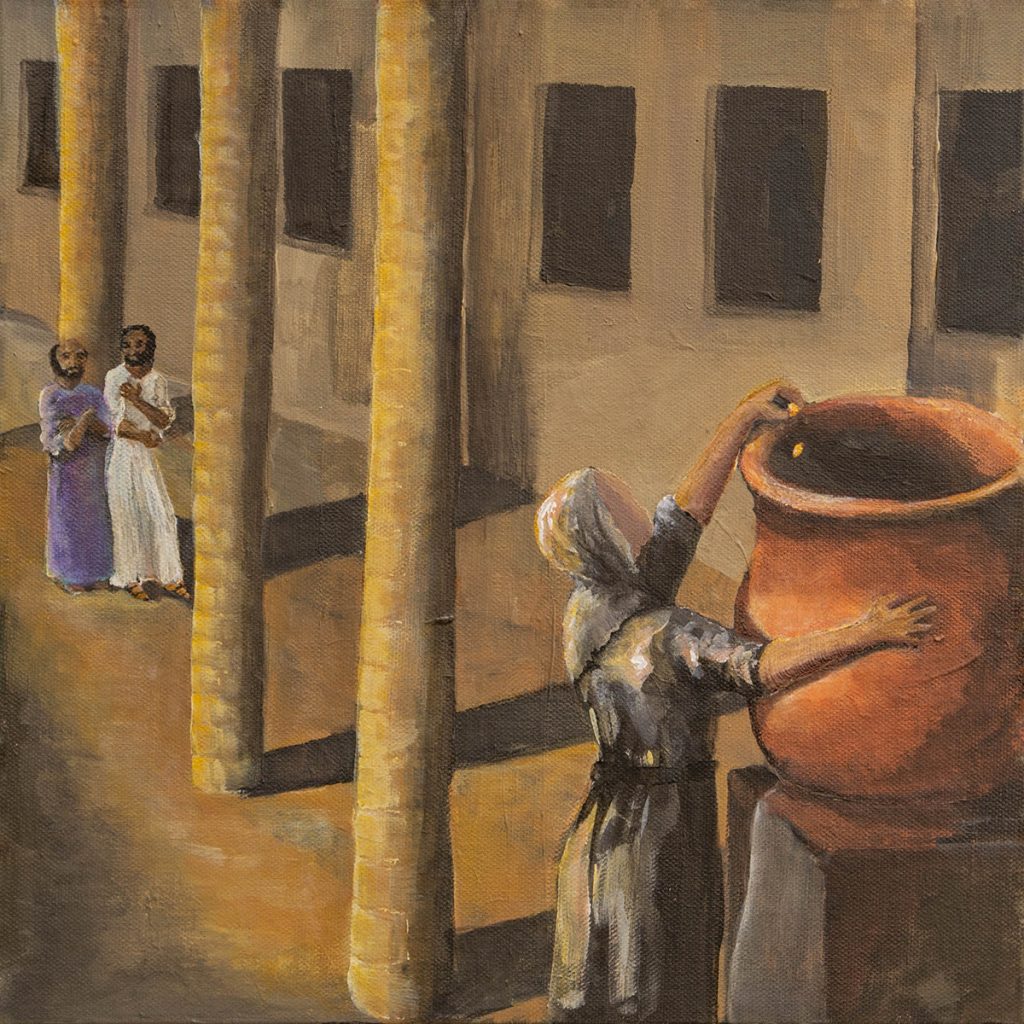
Anna’s story offers some background to the gospel story of the widow’s gift. It takes us beyond the story of a poor and destitute woman. Anna has not always been the poor woman of the gospel, struggling and doubting the faith that has sustained her for so long.

She once knew both material and spiritual security. She had a comfortable life, married with a family. A woman of faith, she’s a descendant of Anna the prophetess, who held the Messiah in her arms. She is called after that Great Aunt and remembers being taught the faith by her. Her faith was the centre of her life:

“The Temple, God’s Temple has been the centre of my life…Wherever I go the Temple is in the corner of my eye…reminding me that no matter what happens, God, my God, is right there with me.”

Then, everything suddenly changes. A mystery illness sweeps through the city, killing her parents, her sons and her husband. Post Covid this scenario touches us deeply, we can no longer dismiss it as something that was only a possibility in the distant past.

She’s left alone and poor. As age and poverty make her increasingly invisible to others she begins to question her faith. Her sense of being held in the loving gaze of God waivers. But it doesn’t quite die.

She makes the hard journey to the Temple to make her last tiny offering. It’s then that Jesus sees and comments on her offering:

“She, out of her poverty has put in everything she possessed, all she had to live on.”

She senses his gaze recognising his love and respect…and everything changes. Once again, she recognises the loving gaze of God on her. This enables her to accept the hospitality her neighbour Miriam offers her as a gift of love.

Where do you need to feel the loving gaze of God in your life this Holy Week?

You can listen to Paula Gooder read Anna’s story here:

Categories
Benedictine Spirituality Christ Discernment Divine Office Lectio Divina Lent Prophetic voices Rule of St Benedict Scripture Uncategorized

Celebrating St Benedict

Photo by Andre Hunter on unsplash.com

Today we’re celebrating the feast of the passing of St Benedict. This post from the archives takes me back to the heart of the Rule, the call to listen…

Lent is the time for turning back to God. It encourages us to reassess our practices and to recommit ourselves to those that will draw us closer to God. With this in mind I’m reflecting on this from the prophet Jeremiah:

“Listen to my voice, then I will be your God and you shall be my people. Follow right to the end the way I mark out for you, and you will prosper.”

His words take me back to the Rule of St Benedict. He begins his rule by saying:

“Listen carefully to the master’s instructions and attend to them with the ear of your heart.”

We all know that listening is central to our faith. We also know how that in the hubbub of challenges and anxieties that make up daily life we can easily miss that gentle voice of God calling us. St Benedict and Jeremiah both call us to take the time to tune the ear of our hearts to resonate with that gentle call.

Lent is certainly a good time to practice this listening, but there’s more to it than that. The listening that they require is a life changing experience. It starts with the attentive listening with the ear of our heart and moves on to action that affects every part of our life.

St Benedict carries on saying that having listened to the master’s instructions we are to “faithfully put into practice” what we hear.

Jeremiah’s call to listen and follow makes the same point. The listening we are called to is to is to shape how we live. The way we treat one another, the way we work, the way we treat our tools and utensils are all to be formed by this attentive listening to God in every circumstance.

As we move through Lent what are you being called to faithfully put into practice?

Categories
Benedictine Spirituality Christ Discernment Gospel Lectio Divina Lent Prayer Prophetic voices Scripture

Christ on the margins

Photo by Vishnu Vijayakumar on unsplash.com

This week I’m reflecting on the blessing of welcoming. I’m aware of how often we’re called to recognise Christ by welcoming what we consider marginal. We see that in today’s gospel. It’s a man who is outcast, ignored and undervalued who recognises and proclaims Christ to his people.

He is the last person anyone would have expected to speak and reflect theologically. We see this in the response of his neighbours, who no longer recognise him, and in the Pharisees who refuse to accept someone so marginal can presume to teach them anything about God.

The man doesn’t crumble under their badgering questions, instead he faces them confidently, reflecting on his experience with Jesus in the light of his Jewish faith, saying to them:

“We know that God doesn’t listen to sinners, but God does listen to people who are devout and do his will. Ever since the world began it is unheard-of for anyone to open the eyes of someone who was born blind: if this man were not from God he couldn’t do a thing.”

As the man moves from claiming that he only knows Jesus’ name to proclaiming and worshipping him as Christ he welcomes him with a truly open heart. It may be that his marginal position helped him to recognise Jesus as the Christ, and give him the freedom to worship him.

This gospel challenges me to be attentive to those parts of myself that I push aside, allowing them to point me towards Christ in ways that I might not expect or be entirely comfortable with.

It also challenges me to be attentive to the people we marginalise today, leaving me with an uncomfortable question, would we respond any better than the Pharisees should any of them proclaim Christ to us?

How is Christ calling you welcome the marginal in your life today?

Categories
Benedictine Spirituality Christ Discernment Gospel Lectio Divina Lent Scripture Uncategorized

Attentive to the call of love

Photo by Surface on unsplash.com

Today’s gospel, the conversation between Jesus and one of the Scribes, is a call to be attentive to the real essentials in life. That’s an important message for us living as we do in times of distraction and shortening attention spans. It highlights two essential aspects of faith that we’re called to be attentive to, love and respect for others.

It’s not clear if the scribe is trying to catch Jesus out on this occasion, or if he is genuinely seeking understanding. Either way, Jesus decides to take the question at face value, treating it a genuine request for greater understanding, and giving the scribe the benefit of the doubt. Having being asked by the scribe about the first of the commandments he replied:

“You must love the Lord your God with all your heart…You must love your neighbour as yourself.

It takes us back to the heart of the gospel and reminds us that love is the core of our faith. Jesus responds with love to the scribe’s question, answering sincerely and respectfully, and ending the conversation by saying:

“You are not far from the kingdom of God.”

Our challenging times make it very easy to hear a criticism in every question and to respond with defensiveness or even aggression so that we lose sight of love and the relationship falters.

This draws us away from the call to love that is the heart of the gospel. Jesus shows us another way to respond, keeping his attention focussed on loving and respecting the scribe.

Where are you being called to be attentive to the call of love this Lent?

Categories
Benedictine Spirituality Christ Discernment Gospel Lectio Divina Lent Rule of St Benedict Saints Scripture

A gospel blessing.

Photo by Kelly Sikkema on unsplash.com

Love is at the very heart of the blessing of gospel living. It can be easy to see this love as an ideal, a valuable principle that we acknowledge then leave on a shelf as we go about the important daily business of living. If that is how we understand love it is unlikely to be a blessing to us or to others.

For love to be a blessing it has to be both the valuable and beautiful principle, and a practical reality in our daily lives. Jesus makes that clear to his disciples in today’s gospel. Turning all our expectations on their heads he says:

“Anyone who wants to be great amongst you must be your servant, and anyone who wants to be first among you must be your slave, just as the Son of Man came not to be served but to serve, and to give his life as a ransom for many.”

His words make it clear that love of gospel living has to affect how we treat others. In chapter 4 of the Rule on the tools of good works St Benedict makes the same point. He reminds us “never do to another what you do not want done to yourself.”

Together the gospel and the Rule bring the blessing of gospel living back to a very basic practice that we can live each day, to treat others as we would like to be treated.

I wonder how life might change if that became the guiding principle of all our interactions. While that might prove costly the blessing of gospel living offers the hope that it will also be a life enhancing experience.

Where are you being called to treat others as you would like to be treated this Lent?

Categories
Benedictine Spirituality Christ Discernment Gospel Lectio Divina Lent Scripture

Beyond appearances

Photo by Gilles Lambert on unsplash.com

Today’s gospel speaks to the heart of what appears to be a very modern dilemma. Jesus is warning his disciples not to fall into the trap of being beguiled by appearances. He warns them against behaving in ways which attract attention and focus on the externals, saying:

“Everything they do is done to attract attention, like wearing broader phylacteries and longer tassels, like wanting to take the place of honour at banquets and the front seats in the synagogues, being greeted obsequiously in the market squares and having people call them Rabbi.”

In an age that seems to be obsessed by appearances his words have a particular resonance. While he wasn’t talking about social media, we all recognise the similarities. Valuable as social media is it constantly presents us with images of “the perfect life” that we are all meant to be living.

This is attractive and beguiling, but not necessarily life-giving. As anyone who spends time on social media is aware this can lead us to be harshly judgemental of others and of ourselves.

This means that what could be a valuable tool becomes a burden to ourselves and to others. This is not the way of the gospel and it carries no blessing with it.

Jesus is quick to show his disciples another way of being. Having told them how not to behave he carries on:

“The greatest among you must be your servant. Those who exalt themselves will be humbled, and those who humble themselves will be exalted.”

His words call us to reflect on how we engage with social media. The call of gospel living is not to make ourselves the centre of attention, but to focus on serving others. It’s blessing for our image obsessed age is that it sets us free from worrying about appearances and from the anxiety and judgement that can come with that.

How is your use of social media reflecting the blessing of gospel living this Lent?

Categories
Benedictine Spirituality Christ Cross Discernment Gospel Lectio Divina Lent Liturgy Prophetic voices Scripture

Living fearlessly

Photo by Luke Moss on unsplash.com

I’ve been slow to write a reflection today. That’s partly a reaction to the world situation. We woke up this morning to a world even more immersed chaos that was yesterday. It made my plan to spend the second week of Lent focusing on the blessing of gospel living seem at best irrelevant. As I watch conflict and chaos spread across the world it’s almost impossible to discover any blessing in life.

This is the natural response in such frightening and unsettled times. We tend to turn in on ourselves, seeking protection and turning away from hope. In such situations it quickly becomes hard to notice the blessing that God continues to lavish on us even in the hardest of times.

In that state of mind this line in our Lauds Canticle from the prophet Isaiah leapt out at me:

“Do not be afraid, for I have redeemed you; I have called you by your name you are mine. Should you pass through the sea I will be with you; or through rivers, they will not swallow you up.”

This wasn’t written to people living safe and stable lives. It was written to a people in exile who had lost their families, their livelihoods, their culture, even their faith.

This caused me to think again about gospel living. If Isaiah’s words could be a blessing for people in exile they can be a blessing for us in our challenging circumstances today. The blessing of living for today is that however dark and frightening our times, however overwhelming our circumstances we are held in the heart of the loving God who will never leave us.

As we begin the second week of Lent do you need to feel that you are held in God’s heart?

Categories
Benedictine Spirituality Christ Cross Discernment Divine Office Lectio Divina Lent Rule of St Benedict Saints Scripture

A habit of listening

Photo by Anastasiya Badun on unsplash.com

Nothing speaks to the hard work of BEGINNING as much as developing a new habit. In today’s first reading Jonah, a reluctant prophet is challenged to develop a new habit of obedience. God calls to him:

“Up!…Go to Ninevah, the great city and preach to them as I told you to”

Perhaps having learned from his earlier disagreement with God Jonah obeys swiftly and without argument or prevarication:

“Jonah set out and went to Ninevah in obedience to the word of the Lord.”

His response can make obedience seem easy, straightforward and simple, but it’s more complex than that. It takes me back to the Rule of St Benedict which calls us to “unhesitating obedience”. This is not a call to simply do what we are told, though it sometimes requires that.

Rather the call to obedience is a call to listen and respond to the call of God. It requires discernment, both to hear the call and discover the response we need to make. In the first instance the call to obedience is a call to listen. Then it is a call to respond to what we hear.

We’re called to develop a habit of listening, to attune ourselves to God’s presence in every situation so that we learn to recognise God’s voice in our lives. From this listening we will be able to discern the response we’re called to make. It’s a process that requires practice. We will make mistakes, getting it wrong, trusting in God’s mercy, and being willing to try again and change direction if necessary.


Where are you being called to begin to develop a habit of listening this Lent?

Categories
Benedictine Spirituality Christ Cross Discernment Divine Office Gospel Lectio Divina Lent Liturgy Rule of St Benedict Scripture Uncategorized

A second chance

Photo by Thomas Scheiner on unsplash.com

In today’s gospel his disciples asked Jesus to teach them to pray. The words he taught them have become one of the best-known, most used, and most loved prayers in Christianity. We know it so well, saying it several times a day, sometime without a great deal of attention. As I reflected on it to date seemed to me a perfect vehicle for reflecting on the blessing of BEGINNING:

“Give us today our daily bread. And forgive us our debts, as we have forgiven those who are in debt to us. And do not put us to the test, but save us from the evil one.”

There is a beginning in the call of today’s gospel to rediscover its many riches from its ordering of the universe to its trust in God’s mercy and love for us. Each day when we pray it offers us the chance to begin again by putting ourselves firmly in that loving and merciful presence. In his rules and Benedict says:

“The celebration of Lauds and Vespers must never pass without the superiors reciting the entire Lord’s prayer at the end for all to hear, because storms of contention are likely to spring up.”

His words remind me of how this prayer is constantly offering us the opportunity to begin again. It acknowledges that we will fail again and again, but it doesn’t give up on us. Instead, it reminds us of the loving mercy of God which is always offering us a new beginning.

The beginning it offers allows us the opportunity to reset our relationship with God and with one another. It doesn’t deny our failures to love God or each other. Instead it offers us, again and again, a second chance, an opportunity to do better next time.

Where is Christ offering you an opportunity to begin again this Lent?